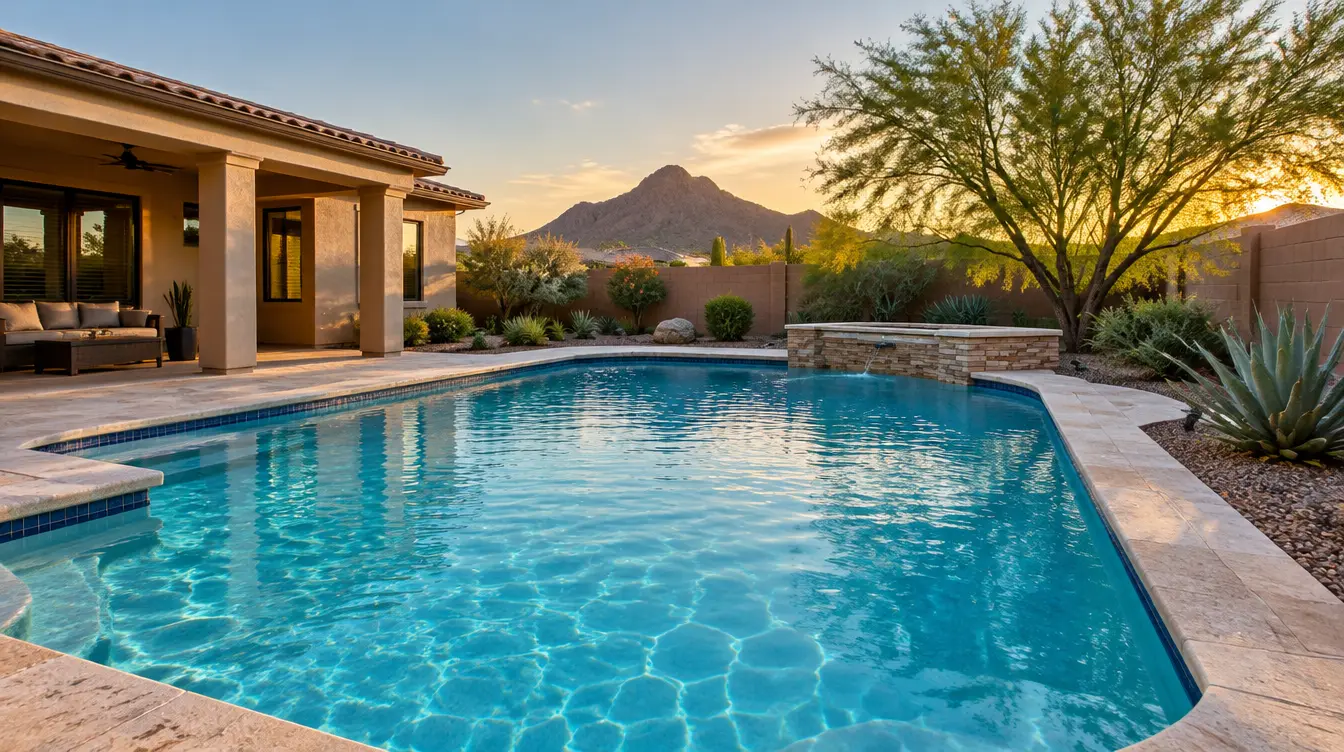
Resurfacing in Phoenix
Resurfacing in Phoenix comes down to three local details: very hard fill water, a drain that has to go down the sewer cleanout slowly, and a refill that costs less in some months than others. A contractor who works the city every week plans for all three before the pool is drained.
- Tap water
- Hard. The city's 2025 water quality report lists 172 to 302 mg/L, or 10 to 17.6 grains per gallon. Nearly all of it is Salt, Verde and Colorado River water, with the rest from city wells.
- Draining your pool
- Through the home's sewer cleanout, at no more than 12 gallons a minute (720 an hour). Not into the street, an alley or other city right of way.
- No cleanout?
- Homes without one, such as homes on septic, can drain to the right of way only with a city permit, under 50 gallons a minute and under 1 ppm chlorine. Saltwater pools and backwash water can't go that way.
Where these facts come from: City of Phoenix 2025 Water Quality Report; City of Phoenix Water Services, pool draining and refilling guidance; City of Phoenix pool barrier requirements. Rules change, so check with your city or water provider before you drain.
Neighborhoods we cover in Phoenix
- Arcadia
- Ahwatukee Foothills
- Laveen
- Sunnyslope
- Maryvale
What to know in Phoenix
Refill in January to March
The city says refilling during the January, February and March billing cycles costs much less than in the higher rate months. A big jump in water use can also raise your sewer fee when it's recalculated in July.
If the sewer fee jumps
Phoenix lets you ask for a sewer fee adjustment through MyPHX311. Ask within 60 days of the July bill, or the request isn't eligible.
Fence or gate work needs a permit
If the job also changes your pool fence or gate, Phoenix requires a permit to alter or replace a pool barrier. Gates must be self-closing and self-latching, with the latch at least 54 inches up.
Phoenix water is hard and alkaline, so new plaster starts on the scale side
Phoenix treats water from three rivers at five city plants: Salt and Verde River water arrives through SRP's canals, Colorado River water through the CAP canal, and about 2% comes from roughly 20 city wells. The city's 2025 report gives one range for the whole system, not one per neighborhood.
What the 2025 report lists
Total hardness of 172 to 302 mg/L (10 to 17.6 grains per gallon), alkalinity of 121 to 167 mg/L, and pH of 6.6 to 8.8.
Why that leans toward scale
High calcium, high alkalinity and high pH all push water toward scale, which is mostly calcium carbonate coming out of the water and landing on the plaster, tile line or equipment. Orenda's start-up guidance aims for slightly scale-forming water in the first days (an LSI of +0.20 to +0.29) and says water much past that can drop the added calcium on the floor as dust. Draining and refilling does not fix scale-forming fill water, because the tap water is the cause.
Ask before you sign
In Phoenix the start-up question is the reverse of soft-water cities like Surprise. Ask each contractor whether they will test the fill water on fill day (calcium hardness, alkalinity, pH) and balance from those numbers, not a standard recipe; who brings alkalinity and pH down if they run high, and who pays for the acid and any scale inhibitor; and how many days of start-up brushing and testing are in the price. Get the answers written into the quote. More on start-up in our pool replastering guide.
White crust at the tile line
Over the years, hard fill water also leaves white scale at the waterline as the pool evaporates and is topped up. If your tile line already shows white crust, ask for a tile cleaning price in the same quote. Tile is quoted separately from the finish; see our pool tile guide.
Where these facts come from: City of Phoenix 2025 Water Quality Report; Orenda, how to manage scale-forming or hard tap water. Check the city's latest report before you fill.
Draining to the sewer cleanout, the Phoenix way
The city's drain flyer sets out how it wants it done.
Use the right cleanout
Use your home's sanitary sewer cleanout. If you have two, use the one closest to the house. A wall cleanout is risky because water can back up into the house. In neighborhoods with alleys, the cleanout is probably in the backyard.
12 gallons a minute at most
12 gallons per minute (720 an hour) is the maximum recommended rate, and the safe rate may be lower depending on your drain line. Watch for water backing up into the house and shut the pump off at once if it does.
Where it can't go
Never into the street, onto a neighbor's yard, into a wash or into a septic tank, and don't leave a drain line in place as a permanent fixture.
Plan for an overnight drain
At 12 gallons per minute a 15,000-gallon pool takes about 21 hours, so draining usually runs overnight. Ask your contractor when they start the pump, who checks it overnight and who watches the cleanout for backup.
Where these facts come from: City of Phoenix Water Services, Drain and Backwash Pools Legally flyer; City of Phoenix Water Services, pool draining and refilling guidance. Rules change, so check with your city or water provider before you drain.
Pool resurfacing in Ahwatukee Foothills
Ahwatukee Foothills is a City of Phoenix village, not its own town, so the Phoenix rules above apply: drain through your sewer cleanout at no more than 12 gallons a minute, and get a city permit if the job changes your pool fence or gate. What's different here is the HOA. Ahwatukee is mostly master planned, single-family neighborhoods, and an HOA architectural committee can add its own sign-off steps.
The Ahwatukee Board of Management
The Ahwatukee Board of Management (ABM) covers the original master planned Ahwatukee community, which it says has more than 5,000 homes. Its Architectural Review Committee guidelines (amended November 19, 2025, effective December 17, 2025) apply to "any exterior home modification, improvement, reconstruction or destruction" and say "Submission for approval to the ARC is always required before any work may commence." The guidelines don't mention pools by name. They do say walls and fences are repaired, replaced or installed with ARC approval, and that gates need prior approval too. So if your resurfacing job also touches a block wall, a gate, a patio or decking, plan for that approval before work starts.
Timing the approval
Applications must be signed by the owner of record. They're due at least 10 days before an ARC meeting, and the committee meets on the first and third Thursdays of each month. The ARC has up to 60 days to give a written decision. If your home is in a sub-association that has its own architectural control, its guidelines come first, so check with that association, not just ABM.
Before you book
Ask your HOA, or your sub-association, whether a like-for-like resurface needs an application, and get the answer in writing. Then book the crew. Our HOA approval guide walks through what to send.
Where these facts come from: City of Phoenix, Ahwatukee Foothills village page; Ahwatukee Board of Management, ARC Procedures and Guidelines (amended Nov 19, 2025); Ahwatukee Board of Management. Rules change, so check with your city or water provider before you drain.
Enter your pool's length, width and depth for a plaster, quartz or pebble range before you get quotes.
What pool resurfacing costs in Phoenix
Tap a finish and your pool size. The real price comes from the on-site quote.
Ballparks scale typical Phoenix-area 2026 ranges by pool size. Chip-out, tile and coping are quoted separately. Enter your exact pool size in the calculator. Read the full cost guide.
After you send the form, up to three licensed pros call or text the number you gave to set a time to see your pool. Calls may come from numbers you don't know. You never owe anything for asking.
Phoenix questions
Do I need a permit to drain my pool in Phoenix?
Not when you drain through the sewer cleanout at no more than 12 gallons a minute. Homes without a cleanout need a permit to drain to the right of way, and alleys are off limits either way.
When is the cheapest time to refill a pool in Phoenix?
The city recommends refilling during the January, February and March billing cycles, when water costs less.
Does Phoenix's hard water change how a new finish should be started up?
Yes. City water ran 10 to 17.6 grains per gallon in 2025 with alkalinity of 121 to 167 mg/L, which leans toward scale. Ask your contractor to test the fill water and balance from those numbers, and to say in the quote who handles bringing pH and alkalinity down.
Do I need HOA approval to resurface my pool in Ahwatukee?
It depends on your association. The Ahwatukee Board of Management's guidelines require ARC approval before any exterior modification or improvement work starts, and walls, fences and gates need approval to repair or replace. They don't name pool resurfacing. Ask your HOA or sub-association in writing before you book, and allow time: applications are due 10 days before a meeting (first and third Thursdays), and the committee has up to 60 days to decide.
Pool resurfacing in nearby cities
Planning guides
- Pool resurfacing costPlaster, quartz and pebble price ranges and what moves your quote.
- Cost calculatorEnter your pool's size for a price range by finish.
- Pool replasteringHow a replaster week goes, what it costs and what to ask.
- Plaster vs quartz vs pebbleCost, lifespan and feel compared for Valley water and sun.
- Best time to resurfaceHeat, the spring rush and Phoenix's refill timing, month by month.
- HOA approval for resurfacingWhat Arizona law says and what to send your HOA before the drain.
Other areas we cover
Scottsdale and Paradise Valley
Scottsdale, North Scottsdale, Paradise Valley, Fountain Hills, Cave Creek
Pool resurfacing in the Scottsdale area
East Valley
Chandler, Gilbert, Mesa, Tempe, Queen Creek
Pool resurfacing in the East Valley
West Valley
Glendale, Peoria, Surprise, Goodyear, Avondale
Pool resurfacing in the West ValleyGet a resurfacing quote this week
Spring dates go fast, so it pays to book early. It takes about a minute to ask.
Start my free quote