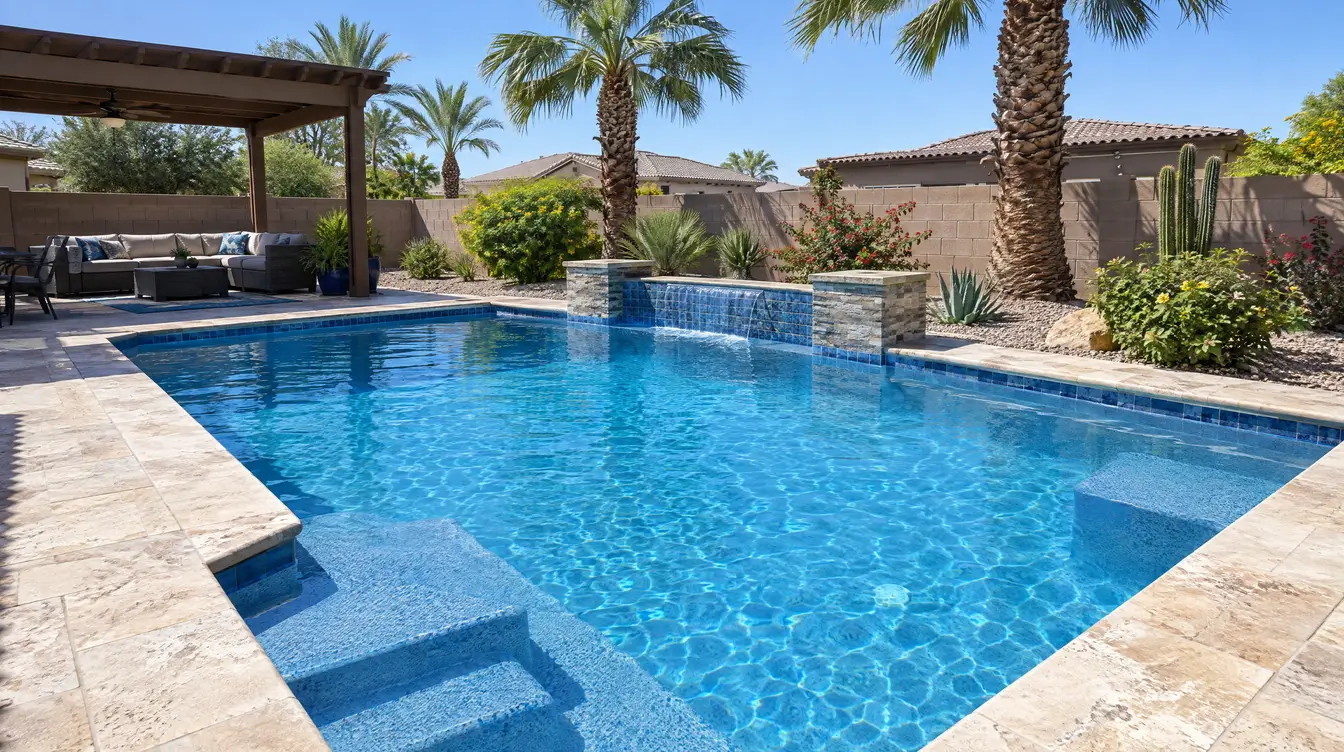
| White plaster | Quartz | Pebble | |
|---|---|---|---|
| Typical Phoenix-area cost | $4k to $8k | $7k to $10k | $7k to $15k |
| Per square foot | $6 to $8 | $7 to $10 | $7 to $15 |
| Typical life in Arizona | 7 to 10 years | 12 to 18 years | 20 to 30 years |
| Feel | Smoothest | Smooth, light texture | Textured, smoother if polished |
| Look | Classic bright blue | Holds color in sun | Natural stone |
| Hides stains and scale | Least | Better | Best |
Lifespans are for Arizona with good water care, from Shasta Pools (January 2026) and ASP North Phoenix. Standard quartz usually lands at 12 to 15 years; premium quartz blends reach toward 18 (Shasta). Pebble Tec, the maker, says its pebble finish lasts over 20 years with proper chemistry.
Hard water and the finish you choose
Phoenix tap water already carries 10 to 17.6 grains per gallon of hardness, and evaporation leaves more calcium behind every month. Smooth white plaster shows scale and etching first. Quartz resists it better, and pebble's texture hides it best. Whatever you pick, keeping calcium hardness in the 200 to 400 ppm range the National Plasterers Council recommends does more for its life than anything else.
Have a salt water pool?
A salt pool is still a chlorine pool. The generator makes chlorine from salt dissolved in the water, so the finish sits in salty water all day. That matters most for cement-based finishes, and plaster, quartz and pebble are all bonded with cement.
How salt affects each finish
River Pools, a pool builder that writes about this often, believes salt slowly wears cement-based finishes. It says the effect is worst on plaster and a little better on aggregate finishes like pebble, and that tile is largely unaffected because it isn't made from cement. It also says plainly that nobody has exact numbers yet on how much salt shortens a finish's life. Its advice is to keep salt in the low to medium part of your generator's range, not at the top.
Wait before adding salt to a new finish
Fresh plaster, quartz and pebble need time to cure before salt goes in. Pebble Tec's care instructions say to wait at least 28 days before adding salt if you use a salt chlorine generator.
AQUA Magazine (onBalance, September 2023) recommends waiting 30 days for plaster pools, including quartz and pebble. The reason it gives: salt added too early dissolves calcium from the fresh surface, pushes the pH up and leaves the finish more porous and weaker. If the finish wasn't put in or started up the right way, it may need longer. Our timeline guide walks through the full 28-day start-up.
Brush salt until it dissolves
Undissolved salt sitting on the floor is the bigger risk. Pebble Tec says salt left on the finish surface may scale, stain or discolor it, and that this damage is not covered by its warranty. A pool chemistry consultant quoted in AQUA Magazine recommends brushing added salt until it is all dissolved. Pour it in, then brush the piles out right away.
How each finish holds up in Arizona sun and heat
Plaster. Phoenix sun and pool chemicals wear plaster down faster than in milder places, and heat makes it more prone to etching and staining. Expect 7 to 10 years here, even though you will see longer national figures. Plaster also needs care going on: in extreme heat it can dry too fast to cure properly, which is one reason crews schedule around summer afternoons.
Quartz. Quartz holds color and resists UV and chemical wear noticeably better than plain plaster. Most quartz mixes are still plaster-based, though, so they can stain and etch in our heat if chemistry drifts. Plan on 12 to 15 years for standard quartz and up to about 18 for premium blends.
Pebble. Exposed stone takes sun, heat and chemical swings best of the three. Over time it tends to soften in color rather than bleach or crack, and the texture hides scale. In Arizona it typically lasts 20 to 30 years, roughly double plaster.
Every finish: these lifespans assume balanced water. Pebble Tec lists water chemistry (pH, alkalinity, calcium hardness), brushing and vacuuming, sun and temperature swings, and how hard the pool is used as what decides how long a finish lasts. The hard water section above has the calcium range to aim for.
What is Diamond Brite?
Diamond Brite is SGM's brand name for a quartz pool finish. SGM's brochure says it combines natural quartz aggregate, polymer-modified cement and SGM's own "Diamond Quartz" accent colors. So when a Valley contractor quotes you "Diamond Brite," they are quoting a quartz finish. Compare it with other quartz quotes, not with pebble.
SGM says the accent colors give the surface a variegated look that masks slight imperfections, and that the quartz is unaffected by pool chemicals and resists permanent staining. The finish comes in about 15 standard colors, plus a Watercolor Series that blends two or more of them.
What Diamond Brite costs and how long it lasts
We haven't found a current, dated source for a Diamond Brite price or lifespan in Phoenix, so we don't quote one. Use the quartz numbers on this page: about $7 to $10 per square foot, typically $7,000 to $10,000 for a Phoenix-area pool, and 12 to 15 years for standard quartz, up to about 18 for premium blends. Ask each contractor to write the exact product line and color on the quote so you are comparing the same thing.
Diamond Brite vs Pebble Tec
Diamond Brite is a quartz finish and Pebble Tec is a pebble finish, so this is really the quartz vs pebble choice. On the ranges above, quartz costs less up front and pebble lasts longer. If you plan to stay a long time, run both through the cost-per-year math below.
Ask about the warranty in writing
SGM says its products are backed by a warranty program and that warranties are registered on its website, but its brochure doesn't give the residential terms. The one 10-year extended warranty the brochure names is for Premium Commercial White on commercial pools, not home pools. Ask your installer which SGM warranty applies, who registers it, and what water care it requires, and get the answer in writing.
Look at the cost per year
Divide the price by the years it lasts. White plaster at $6,000 over 8 years is $750 a year. Pebble at $11,000 over 20 years, the low end of its Arizona range, is $550 a year. If you plan to stay in the home, pebble often comes out ahead.
Read the warranty before you pick
Finish warranties differ more than prices do. Pebble Tec, for example, offers at least 5 years on materials plus at least 5 years on workmanship from its authorized installers, but the warranty can't be transferred to a new owner and a claim needs your water chemistry records. Ask each contractor for the finish maker's warranty in writing, and keep a log of your water tests.
Which one is right for you
Pick white plaster if
You want the lowest cost, may sell in the next few years, or love the classic bright blue water.
Pick pebble if
You plan to stay for years. It lasts longest, and its texture hides the scale Phoenix water leaves behind.
Where these numbers come from: HomeGuide pool resurfacing cost guide; SGM Diamond Brite brochure (2020); River Pools, salt water in concrete pools (updated September 13, 2023); Pebble Tec pool care instructions; AQUA Magazine, when should salt be added to newly plastered pools (onBalance, September 28, 2023); AQUA Magazine on chlorine generators (May 19, 2009); Shasta Pools, plaster vs pebble (2026) and which finishes hold up best in Arizona sun and heat (January 2026); ASP North Phoenix pool remodeling (Arizona finish lifespans); Pebble Tec on finish lifespan and warranties; National Plasterers Council water chemistry guidance; City of Phoenix 2025 Water Quality Report. Prices are ranges, not quotes.
Common questions
Is pebble rough on your feet?
Standard pebble has more texture than plaster. Smaller or polished pebble finishes feel smoother, so ask to touch a sample before you choose.
Which pool finish lasts longest in Arizona?
Pebble lasts longest. Arizona pool builders put it at 20 to 30 years, against 12 to 18 for quartz and 7 to 10 for plaster, and Pebble Tec says its finish lasts over 20 years with proper chemistry. Its texture also hides hard water scale better than smooth plaster.
Can I switch finishes when I resurface?
Yes. Resurfacing is the time to switch, for example from white plaster to quartz or pebble. Your contractor preps the old surface so the new one bonds, with a bond coat or a full chip-out. Our replastering guide explains which fits when.
Does the finish change the water color?
Yes. White plaster gives the bright classic blue. Darker quartz and pebble colors make the water look a deeper blue or green.
Is Diamond Brite quartz or pebble?
Quartz. SGM describes Diamond Brite as natural quartz aggregate in polymer-modified cement, with its Diamond Quartz accent colors. It is priced and compared as a quartz finish.
How much does Diamond Brite cost in Phoenix?
We don't have a current brand-specific price. Plan on quartz pricing: about $7 to $10 per square foot, typically $7,000 to $10,000 for a Phoenix-area pool. Your quote depends on the pool's size and condition.
Which pool finish is best for a salt water pool?
No finish is untouched by salt, since plaster, quartz and pebble are all cement-based. A builder who writes about salt pools says plaster wears fastest and aggregate finishes like pebble hold up a little better, while tile is largely unaffected. Whatever you pick, wait about 28 to 30 days before adding salt, keep salt in the low to medium range and brush new salt until it dissolves.
How long after resurfacing can I add salt?
Pebble Tec says at least 28 days for its finishes, and AQUA Magazine recommends 30 days for plaster, quartz and pebble. Wait longer if the start-up wasn't done properly. Your contractor's start-up instructions come first.
Planning guides
- Pool resurfacing costPlaster, quartz and pebble price ranges and what moves your quote.
- Cost calculatorEnter your pool's size for a price range by finish.
- Pool replasteringHow a replaster week goes, what it costs and what to ask.
- Pool tile and copingWaterline tile and coping costs, and why to do them in one drain.
- Signs it's timeEight signs your pool surface is worn out, and what each one means.
- Acid wash or resurfaceWhen an acid wash is enough, and when it just delays the real fix.
- Pool remodel costFinish, tile, coping and deck in one job: ranges and licenses.
- Choosing a contractorLicense checks, written quotes, contracts and payments in Arizona.
- Pebble Tec costPebble Tec prices by pool size and line, plus the warranty.
- Best time to resurfaceHeat, the spring rush and Phoenix's refill timing, month by month.
- HOA approval for resurfacingWhat Arizona law says and what to send your HOA before the drain.
- Paying for a resurfaceCash, pool loans, home equity or a card promo: what to compare.
- Pool deck resurfacing costPer square foot prices to resurface or replace a pool deck.
- How long resurfacing takesDrain to swim: each step, what slows it and how to plan.
- Selling or buying a homePool plaster flagged in an inspection: deadlines, licensed repairs, quotes.
- Patch or resurface?Chips, cracks and hollow spots: when a patch holds and when it won't.
- Picking a finish colorWhite, gray, blue or dark: how each shade looks, stains and fades in our sun.
- Warranties and your rightsMaterial vs workmanship warranties, what limits them, and ROC complaints.
- How long a resurface lastsPlaster, quartz and pebble lifespans here, and what wears them out.
- Resurface or remove the poolRemoval and fill-in costs next to resurfacing, plus the permit step.
- Check your quoteIs your resurfacing quote fair? Price, line items and contract checks.
Get local quotes
Scottsdale and Paradise Valley
Scottsdale, North Scottsdale, Paradise Valley, Fountain Hills, Cave Creek
Pool resurfacing in the Scottsdale area
East Valley
Chandler, Gilbert, Mesa, Tempe, Queen Creek
Pool resurfacing in the East Valley
West Valley
Glendale, Peoria, Surprise, Goodyear, Avondale
Pool resurfacing in the West ValleyGet a resurfacing quote this week
Spring dates go fast, so it pays to book early. It takes about a minute to ask.
Start my free quote