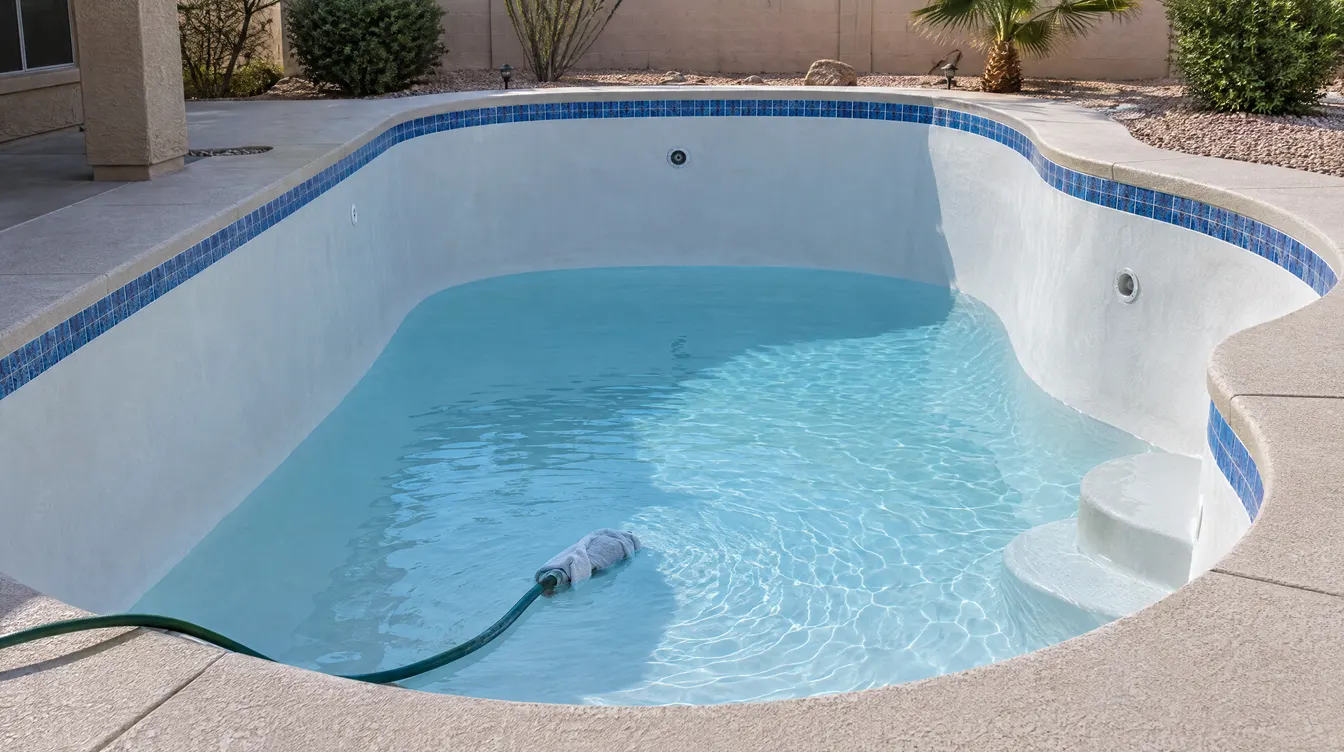
Replastering or resurfacing?
They mean nearly the same job. Replastering usually means a new white plaster or quartz plaster coat. Resurfacing covers any new interior finish, pebble included. Either way, the old surface is prepped and a new one goes on.
How a replaster week usually goes
- Drain. The pool is pumped out under your city's rules. At the common 12 gallon a minute limit, a 15,000 gallon pool takes most of a day.
- Prep. The crew opens the hydrostatic relief valve so groundwater can't push up the empty shell. Then the old surface is chipped out, or gets a bond coat so the new one sticks.
- Tile and repairs. Cracks are patched, and new waterline tile goes on now if you are replacing it.
- Plaster. The crew trowels on the new finish in coats, with drying time between them.
- Refill. Water goes back in right away and runs without stopping until the pool is full, with nobody in the pool.
- Startup. Brushing and water chemistry over the next 28 days shape how the new surface wears.
Chip-out or bond coat: what happens to your old surface
New plaster only lasts if it's bonded to something solid. Before any new finish goes on, the crew drains the pool and deals with the old surface in one of two ways: a bond coat over plaster that's still sound, or a full chip-out down to the shell.
Bond coat
A bond coat is a cement-based layer made to grab both the old surface and the new finish. It's used when most of the old plaster is still firmly attached. The crew still cuts the old plaster back in a few places first: right under the tile line and around fittings like returns and drains, so the new finish can sit flush there. Pool & Spa News's prep primer says the bond coat should sit at least a day but no more than three before the new finish goes on, and that experts recommend finishing it before the air or surface reaches 90 degrees.
Full chip-out
A full chip-out removes the old plaster across the whole pool. Contractors turn to it in four cases. When a lot of the surface has come loose: some do a full chip-out once more than 10 percent of the pool is debonded, others wait until it's closer to 25 percent. When the pool has been replastered before and has stacked layers: one plasterer quoted in Pool & Spa News chips off the top two layers so only one comes back. When the pool has an in-floor cleaning system, since so much cutting around all those heads is needed anyway. And when the job is a bigger renovation than a simple resurface.
Hollow spots get removed, never covered
Delaminated plaster (patches that have separated from the layer under them) must come out, not be plastered over. Crews find them once the pool is drained by dragging a chain, rod or piece of rebar across the surface and listening: solid plaster scratches, a hollow spot sounds like tapping a bucket. Plastering straight over old plaster that hasn't been prepped this way is how new finishes end up bubbling and lifting.
Ask this before you sign
"Which prep are you planning, and what happens to the price and schedule if you find hollow spots once it's drained?" Get the answer in the written quote. Our guide to checking a pool resurfacing quote covers what else should be on it.
What Phoenix does to plaster
Phoenix tap water runs 172 to 302 mg/L of hardness, or 10 to 17.6 grains per gallon, per the city's 2025 report. The National Plasterers Council recommends keeping calcium hardness at 200 to 400 ppm for plaster, so Valley fill water starts near the top of that range. Then evaporation pushes it higher: Mesa estimates a 400 square foot pool loses about 19,664 gallons a year, and the minerals stay behind. That's why scale builds fast here and why steady water balance matters more than anywhere else.
Timing matters too. Phoenix-area builders report a spring rush starting around March, with more open dates from December to February. In summer, crews start early because heat shortens how long plaster stays workable, and the empty shell shouldn't sit dry: one industry guide says never leave plaster without water for more than about a week.
What a replaster costs
In the Phoenix area, white plaster typically runs about $4,000 to $8,000 and quartz about $7,000 to $10,000 for an average backyard pool. Draining and cleaning adds roughly $600 to $650 in national cost guides, and a hose refill usually runs $100 to $250 in the Phoenix metro. Size, prep and tile move the number, so an on-site measurement is the only price to plan around.
The first 28 days
The National Plasterers Council, the plastering trade group, publishes a startup procedure for new plaster. Ask your contractor which startup they use. The main points of the NPC's:
- Fill without stopping. Fill as fast as possible, with nobody in the pool.
- Run the pump. Keep the filter running continuously for the first 72 hours at least, and ideally a week.
- Brush every day. Brush the whole surface at least twice a day, and keep that up through the first 14 days.
- Hold the chlorine. No chlorine for the first 48 hours, then bring calcium hardness to at least 200 ppm by day 4.
- Park the robot. No wheeled automatic cleaner for 28 days, and no heater until the water is balanced and the plaster dust is gone.
Check the license class, not just the license
Arizona's Registrar of Contractors (ROC) licenses pool work by class. A B-5 (residential pools and spas) or KA-5 license covers building and repairing pools, and R-36 plastering covers pool interiors, excluding tile. An R-6 pool service license does not allow a complete replacement of a plaster or pebble interior, so a service company can't legally do a full replaster.
Look up the license number and class on the ROC's contractor search before you sign. Hiring a licensed residential contractor also gives you access to Arizona's Residential Contractors' Recovery Fund, which can pay up to $30,000 per homeowner if a licensed contractor doesn't finish the job.
Six things to ask a replaster contractor
Prep method
Full chip-out or bond coat? Ask which one, why it fits your pool, and what changes if they find hollow spots after draining.
Startup plan
Who handles startup chemistry and brushing, and for how long.
Warranty
What the finish maker's and the installer's warranties cover, and for how long. Many require water chemistry records, so keep yours.
License
Their ROC license number and class. B-5, KA-5 or R-36 covers a replaster; R-6 service alone doesn't.
Draining
How and where they will drain the pool under your city's rules.
Schedule
Drain, plaster and refill dates in writing.
Ready to ask these? Get up to three quotes from licensed local pros and compare their answers side by side.
Where these numbers come from: City of Phoenix 2025 Water Quality Report; National Plasterers Council startup procedure (2021); City of Mesa water conservation, pool leaks; HomeGuide pool resurfacing cost guide; Shasta Pools Phoenix cost and timing guides (2024 to 2026); Pool Research guides on the plaster process and popped pools; Pool & Spa News, primer on preparing surfaces for plaster and pebble (May 25, 2016); Arizona Administrative Code R4-9-103 and R4-9-104, contractor license classes; Fox 10 Phoenix on the Residential Contractors' Recovery Fund (2026). Prices are ranges, not quotes.
Common questions
How long does replastering a pool take?
Shasta Pools, a Valley builder, says a simple resurface usually takes about 1 to 2 weeks. Tile, repairs or a full remodel add time.
When can I swim after a replaster?
Nobody should be in the pool while it fills. After that it depends on the finish and the startup method, so follow your contractor's startup instructions and keep brushing through the first 28 days.
How long can a pool sit empty?
As short a time as possible. Plaster left dry can shrink and crack, and one industry guide says never to leave it without water for more than about a week. Crews also open the hydrostatic relief valve while it's empty so groundwater can't lift the shell.
Is quartz plaster worth it over white plaster?
Quartz costs more but usually lasts longer, about 12 to 18 years in Arizona versus 7 to 10 for white plaster, and it holds its color better in strong sun.
Can you replaster over existing plaster?
Yes, if the old plaster is still firmly attached: the crew cuts it back at the tile line and around fittings, then applies a bond coat so the new finish grips. Hollow or loose areas have to be chipped out first, and a pool with a lot of loose plaster or several old layers usually gets a full chip-out.
Planning guides
- Pool resurfacing costPlaster, quartz and pebble price ranges and what moves your quote.
- Cost calculatorEnter your pool's size for a price range by finish.
- Plaster vs quartz vs pebbleCost, lifespan and feel compared for Valley water and sun.
- Pool tile and copingWaterline tile and coping costs, and why to do them in one drain.
- Signs it's timeEight signs your pool surface is worn out, and what each one means.
- Acid wash or resurfaceWhen an acid wash is enough, and when it just delays the real fix.
- Pool remodel costFinish, tile, coping and deck in one job: ranges and licenses.
- Choosing a contractorLicense checks, written quotes, contracts and payments in Arizona.
- Pebble Tec costPebble Tec prices by pool size and line, plus the warranty.
- Best time to resurfaceHeat, the spring rush and Phoenix's refill timing, month by month.
- HOA approval for resurfacingWhat Arizona law says and what to send your HOA before the drain.
- Paying for a resurfaceCash, pool loans, home equity or a card promo: what to compare.
- Pool deck resurfacing costPer square foot prices to resurface or replace a pool deck.
- How long resurfacing takesDrain to swim: each step, what slows it and how to plan.
- Selling or buying a homePool plaster flagged in an inspection: deadlines, licensed repairs, quotes.
- Patch or resurface?Chips, cracks and hollow spots: when a patch holds and when it won't.
- Picking a finish colorWhite, gray, blue or dark: how each shade looks, stains and fades in our sun.
- Warranties and your rightsMaterial vs workmanship warranties, what limits them, and ROC complaints.
- How long a resurface lastsPlaster, quartz and pebble lifespans here, and what wears them out.
- Resurface or remove the poolRemoval and fill-in costs next to resurfacing, plus the permit step.
- Check your quoteIs your resurfacing quote fair? Price, line items and contract checks.
Get local quotes
Scottsdale and Paradise Valley
Scottsdale, North Scottsdale, Paradise Valley, Fountain Hills, Cave Creek
Pool resurfacing in the Scottsdale area
East Valley
Chandler, Gilbert, Mesa, Tempe, Queen Creek
Pool resurfacing in the East Valley
West Valley
Glendale, Peoria, Surprise, Goodyear, Avondale
Pool resurfacing in the West ValleyGet a resurfacing quote this week
Spring dates go fast, so it pays to book early. It takes about a minute to ask.
Start my free quote